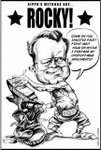


Sippo: Scott is very well read in the Patristic literature and is on the cutting edge of modern biblical scholarship. Anyone who has tried to keep up with the field knows that the movement for "biblical theology" is a new and exciting area of study that crosses confessional lines and participates in the New Pauline Perspective which has been systematically dismantling the classical Protestant interpretation of Scripture in favor of a view of soteriology that is more favorable to the traditional Catholic position.
R. Sungenis: Thanks for proving my point. In case you didn't catch it, Sippo has admitted by the statement "crosses confessional lines and participates in the New Pauline Perspective," that he and Hahn have received their newfound ideas on soteriology from Protestants. Need I say more?
http://www.preteristarchive.com/PartialPreterism/catholic-apologetics-international_03_ga_01.html
In good conscience, I cannot let this comment pass. It betrays not only Mr. Sungenis' narrow prejudices with regard to what he feels is Catholic orthodoxy but it also betrays his refusal to join in full dialog with real scholars struggling to understand St. Paul's sitz im leben as a 1st Century Jew. This latter endeavor must be the spear head of any modern attempt to engage Protestants is serious ecumenical dialog on the merits of their foundational beliefs about justification. If it can be shown by the best of ECUMENICAL scholarship that Luther was wrong and that the Catholic objections to the Protestant religions were justified, then we have a most powerful argument with which to lead our Protestant brethren back into the Church. The New Perspective on St. Paul (NPSP) can be a part of this endeavor.
Among the Catholic concerns are to preserve the integral necessity of good works in Christian salvation (Matt 25:31ff, Romans 2:7, James 2:20ff), the transformative power of Sanctifying Grace through Baptism (Romans 6:1ff) , love of God and neighbor as fulfilling the requirements of the Jewish Law (Luke 10:25ff, Romans 13:7-10), and good works as the final cause of our justification (Ephesians 2:8-10).
The NPSP has its roots in the early 20th Century when Protestant and Jewish scholars began to seriously reflect on the Jewish background of Jesus. Many times in debates during the Deformation, Catholic exegetes had argued that St. Paul was not as concerned in his writings about Pelagianism as he was about Judaizing. These arguments generally fell on deaf ears. But men like Alfred Edersheim, George Moore, Adolf Schlatter and C. G Montifiore started to discuss them openly challenging the narrow views of Protestant orthodoxy. At that time, Protestant exegesis was still strongly influenced by apologetic concerns and confessional theology. And we must also recognize that a nascent theological anti-Semitism made it had for Christians to find anything worthwhile in Judaism. It just made sense in that context that St. Paul was attacking Judaism per se as a religion of "works righteousness".
In the aftermath of WWII, Christian scholars took a more positive and sympathetic look at Judaism, both ancient and modern. The pioneer work in this field was "Paul and Rabbinic Judaism " by W. D. Davies. While this book would be considered somewhat dated by today's standards, it was a break through for Christian scholarship about Judaism. Then in 1960 Swedish scholar Krister Stendahl gave his seminal talk "Paul and the Introspective Conscience of the West." In this talk, he showed that the performance anxiety that concerned St. Augustine in his Confessions and Luther in his Tower Experience was not present in the writings of St. Paul. Paul had a robust conscience and was not tortured by fears of his own inadequacy or the impossibility of pleasing God. St. Paul was more concerned with living the "new life in Christ" and continued to do so while remaining a practicing Jew.
The next major milestone was the book "Paul and Palestinian Judaism" by E. P. Sanders. It was the first in a series of books exploring the interface between Jesus, St. Paul and the Judaism of the first century. James D. G. Gunn contributed his insights in his Romans and Galatians commentaries and in a series of Books on Jesus and St. Paul. The central theme of these books was a systematic critique of classical Reformation exegeses of the Scriptures across the board but most centrally on the issue of justification. They made it clear that IN CONTEXT the Protestant idea of a purely forensic justification existed neither in the Bible nor in the Pseudepigraphal literature. In fact righteousness in Judaism was inseparable from orthopraxis and Jesus and St. Paul reaffirmed this.
In the book The Justice of God: A Fresh Look at the Old Doctrine of Justification by Faith by James D. G. Dunn and Alan M. Suggate, this idea is fleshed out in detail. Some scholars thought that they had gone too far towards the Pelagian end of the Spectrum (e.g., Scott Hahn). But in my opinion we were seeing the pendulum swinging back towards a more robust and Catholic understanding of the integral nature of works with faith.
Other authors like N. T. Wright, Don Garlington, John Gager, and Brendan Byrne S. J. have continued to develop NPSP and thereby undermine the credibility of the Protestant system. Some of the Protestants in this movement have tried to deny the "Catholicity" of this new turn (e.g., N.T. Wright), but Dr. Francis Beckwith on his return to the Catholic Church made it clear that the coherence of the historic Catholic witness on justification with the Bible was one thing which motivated him to revert.
We are in the midst of an apologetics revolution. Protestant scholarship is sawing off the limb it has been standing on and we are seeing the beginning of what I anticipate to be a ground swell of Protestant theologians returning to Catholic orthodoxy.
Mr. Sungensis sadly cannot see this. He is not alone among Catholic scholars in not following the NPSP. Fr. Joseph Fitzmyer S.J. also does not accept it. But Bob seems to forget that Catholicism is not a theological monolith and that good Catholics may disagree on some matters of theology. Sadly, I am concerned that part of Bob's motivation in rejecting NPSP is an excessive antipathy to Judaism which does not allow him to see much good even in the Judaism of the 1st Century. In this attitude he is way out of touch with the teaching Church from VCII, JPII, and BXVI.
In any case, the idea that Dr. Hahn and I "get" our soteriology from Protestants is ludicrous. We get it from God's Inspired Word, the Tradition of the Catholic Church, and the Magisterium. Whenever we find a matter of exegesis where we can agree with our Separated Brethren, we rejoice in it as another opportunity to draw us closer together so that as Jesus wished we might be one even and he and the Father are one.
ADDENDUM: It has recently come to our attention that two Protestants scholars have recently reconciled with the Catholic Church: Dr. Francis Beckwith and Dr. Robert Koons. Both of them have made it clear that recent scholarship which has called into question the traditional Protestant interpretation of St. Paul was instrumental in their decision. I think NPSP is starting to bear fruit!
Art
